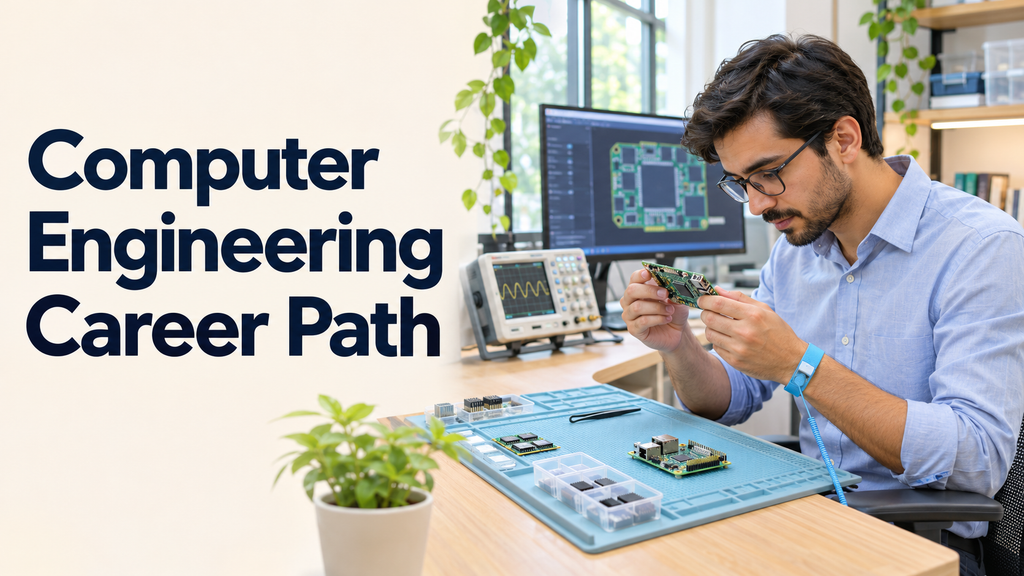
Computer engineering sits at the meeting point of electronics and computing. Computer engineers design the hardware and low-level software that make modern technology work, from the chips in smartphones and the processors in data centres to the embedded systems inside cars, medical devices, aircraft, robots and smart home gadgets. As demand grows for AI hardware, electric vehicles, defence systems, renewable energy and connected devices, computer engineers are among the most sought-after technical professionals.
This guide explains the computer engineering career path in the UK: what computer engineers do, the main specialisms, the skills you need, education routes (including degrees and apprenticeships), professional registration, salaries, career progression, the industries hiring and practical tips to help you get started.
Table of Contents
What Is Computer Engineering?
A Simple Definition
Computer engineering is a branch of engineering that combines electrical and electronic engineering with computer science. Computer engineers design, build, test and improve computer hardware, embedded systems and the software that interacts closely with hardware.
Computer Engineering vs Related Fields
| Field | Main Focus |
|---|---|
| Computer engineering | Hardware, embedded systems, hardware-software integration |
| Computer science | Software, algorithms, theory of computation |
| Electrical/electronic engineering | Circuits, power, signals and electronics |
| Software engineering | Designing and building software applications |
| Information technology (IT) | Managing and supporting technology systems |
What Computer Engineers Do
- Design processors, microcontrollers and circuit boards
- Develop embedded software and firmware
- Integrate hardware with operating systems and applications
- Test and debug hardware and low-level software
- Optimise systems for performance, power and cost
- Work on networking, communications and security hardware
- Build systems for robotics, automotive, aerospace and medical devices
Main Computer Engineering Specialisms
Embedded Systems Engineering
Designs computer systems built into other products, such as cars, appliances, wearables and industrial equipment.
- Key skills: C/C++, microcontrollers, real-time operating systems (RTOS), hardware interfaces
Firmware Engineering
Writes low-level software that controls hardware directly.
- Key skills: C, assembly, device drivers, debugging tools
Hardware Design Engineering
Designs circuit boards, components and computer hardware.
- Key skills: Circuit design, PCB layout, schematic capture, signal integrity
Digital Design and FPGA Engineering
Designs digital logic for field-programmable gate arrays (FPGAs) and custom chips.
- Key skills: VHDL, Verilog, SystemVerilog, timing analysis
Semiconductor and Chip Design (ASIC)
Designs integrated circuits and processors.
- Key skills: Digital and analogue design, verification, physical design, EDA tools
Verification Engineering
Tests chip designs before manufacture to ensure they work correctly.
- Key skills: SystemVerilog, UVM, simulation, scripting
Computer Architecture
Designs how processors, memory and systems are organised for performance and efficiency.
Robotics and Automation Engineering
Combines hardware, sensors, control systems and software to build robots and automated systems.
Networking and Communications Hardware
Develops routers, wireless devices, 5G equipment and communication systems.
Hardware Security Engineering
Protects devices and chips from attacks and tampering.
AI Hardware and Edge Computing
Designs hardware and systems optimised for running AI models, from data centre accelerators to low-power edge devices.
Specialisms at a Glance
| Specialism | Typical Tools/Languages | Example Industries |
|---|---|---|
| Embedded systems | C, C++, RTOS, Linux | Automotive, consumer electronics, medical devices |
| Firmware | C, assembly | IoT, telecoms, industrial |
| Hardware design | PCB design tools, simulation | Electronics, defence, aerospace |
| FPGA/digital design | VHDL, Verilog | Defence, telecoms, finance |
| ASIC/chip design | SystemVerilog, EDA tools | Semiconductors |
| Verification | SystemVerilog, UVM, Python | Semiconductors |
| Robotics | C++, Python, ROS | Manufacturing, logistics, healthcare |
| Networking hardware | C, networking protocols | Telecoms |
| Hardware security | Cryptography, secure design | Defence, finance, tech |
| AI hardware | Computer architecture, accelerators | Data centres, edge AI |
Essential Skills for Computer Engineers
Technical Skills
| Skill Area | What to Learn |
|---|---|
| Programming | C, C++, Python, assembly |
| Digital electronics | Logic gates, flip-flops, state machines |
| Analogue electronics | Circuits, amplifiers, signals |
| Microcontrollers and microprocessors | Arm, RISC-V, peripherals |
| Computer architecture | CPUs, memory, caches, pipelines |
| Operating systems | Linux, RTOS, kernels, drivers |
| Hardware description languages | VHDL, Verilog, SystemVerilog |
| Circuit and PCB design | Schematics, layout, simulation |
| Communication protocols | UART, SPI, I2C, CAN, Ethernet, USB |
| Testing and debugging | Oscilloscopes, logic analysers, JTAG |
| Version control | Git |
Emerging Skills
- Embedded machine learning (TinyML)
- RISC-V architecture
- Cybersecurity for embedded and IoT devices
- Low-power and energy-efficient design
- Functional safety standards (automotive and industrial)
- Cloud-connected and edge devices
Soft Skills
- Problem-solving and analytical thinking
- Attention to detail
- Teamwork across hardware and software teams
- Clear technical communication and documentation
- Project and time management
Education Routes Into Computer Engineering
School Subjects
For most university routes, maths and physics at A-level (or equivalent Scottish Highers) are highly recommended. Computer science, further maths and electronics are useful additions.
University Degrees
| Degree | Length (England) | Notes |
|---|---|---|
| BEng Computer Engineering / Electronic and Computer Engineering | 3 years | Bachelor’s degree |
| MEng Computer Engineering | 4 years | Integrated master’s, often preferred for Chartered Engineer route |
| BSc Computer Science (hardware focus) | 3 years | Option for those leaning towards software |
| MSc (conversion or specialist) | 1 year | For graduates moving into computer engineering |
| PhD | 3–4 years | Research, advanced chip and architecture roles |
Choose an Accredited Degree
Degrees accredited by professional bodies such as the Institution of Engineering and Technology (IET) or BCS can support your path to professional registration.
Placement Years
Many UK universities offer a year in industry. This can give valuable experience, build contacts and often lead to graduate job offers.
Apprenticeships
Apprenticeships let you earn a salary while gaining qualifications, with training costs usually covered by your employer and government funding.
| Apprenticeship Level | Equivalent To |
|---|---|
| Level 3 (Advanced) | A-levels |
| Level 4–5 (Higher) | Foundation degree or HNC/HND |
| Level 6–7 (Degree) | Bachelor’s or master’s degree |
Engineering, electronics and embedded systems apprenticeships are offered by employers in defence, aerospace, automotive, telecoms and electronics.
Other Routes
- T Levels: Technical qualifications in digital or engineering subjects
- HNC/HND: Vocational qualifications that can lead to degree top-ups
- Bootcamps and online courses: Useful for upskilling in embedded programming, FPGA or chip design
Comparing Routes
| Route | Pros | Cons |
|---|---|---|
| Degree | Deep theory, strong graduate opportunities | Tuition costs and student debt |
| Degree apprenticeship | Earn while learning, degree with no tuition fees | Competitive, fewer places |
| Higher apprenticeship | Practical skills and pay | May need further study for senior roles |
| Self-study and courses | Flexible, low cost | Harder to prove skills without a portfolio |
Professional Registration
Engineering Council Titles
In the UK, engineers can gain professional registration through the Engineering Council, usually via a professional body such as the IET.
| Title | Typical Requirements |
|---|---|
| Engineering Technician (EngTech) | Level 3 qualifications and experience |
| Incorporated Engineer (IEng) | Bachelor’s degree or equivalent plus experience |
| Chartered Engineer (CEng) | Accredited MEng (or bachelor’s plus further learning) plus professional experience |
Why It Matters
Chartered status demonstrates professional competence and commitment, can improve career prospects and salary, and may be required for senior or safety-critical roles.
Professional Bodies
- Institution of Engineering and Technology (IET)
- BCS, The Chartered Institute for IT
- Institute of Physics (for some hardware roles)
Computer Engineering Salaries in the UK
Electronics and Hardware Roles
Salaries vary by specialism, sector and location. A 2026 UK engineering salary guide lists Electronics Design Engineer / Electronics Engineer £30,000 – £34,000 £36,000 – £46,000 £48,000 – £68,000 for junior, mid-level and senior roles respectively.
Embedded and Software-Heavy Roles
Embedded roles that combine hardware and software skills often pay more. IT Jobs Watch data shows the median Senior Embedded Engineer salary in the UK is £70,000 per year, according to job vacancies posted during the 6 months leading to 23 June 2026.
Indicative Salary Ranges
| Role | Junior | Mid-Level | Senior |
|---|---|---|---|
| Electronics engineer | £30,000–£34,000 | £36,000–£46,000 | £48,000–£68,000 |
| Embedded engineer | £35,000–£45,000 | £50,000–£65,000 | £65,000–£80,000+ |
| FPGA engineer | £35,000–£50,000 | £55,000–£75,000 | £75,000–£100,000+ |
| ASIC/chip design engineer | £40,000–£55,000 | £60,000–£85,000 | £85,000–£120,000+ |
| Verification engineer | £40,000–£55,000 | £60,000–£80,000 | £80,000–£110,000+ |
Indicative ranges based on recruitment market data. Actual pay varies by employer, location and specialism.
Sector Premiums
Specialist sectors often pay more. The same 2026 salary guide notes that defence, aerospace, energy, pharma/med‑tech and semiconductor often command 5%–15% premiums, especially with SC/DV clearance or Class III/ASIL/SIL exposure.
Contracting
Experienced engineers can work as contractors. The guide puts typical electronics design engineer contract rates at £400 – £550 a day.
Skills Shortages
Demand remains strong in specialist areas. According to the guide, scarce skills in electronics, embedded, controls/automation and regulated sectors continue to attract a premium.
Computer Engineering Career Progression
Typical Career Ladder
| Stage | Typical Role | Experience |
|---|---|---|
| Entry | Graduate or apprentice engineer | 0–2 years |
| Early career | Engineer | 2–5 years |
| Mid-career | Senior engineer | 5–10 years |
| Advanced | Principal engineer or technical lead | 10+ years |
| Leadership | Engineering manager, head of engineering | 10+ years |
| Expert | Distinguished engineer, chief architect | 15+ years |
Technical vs Management Tracks
Many companies offer two paths:
- Technical track: Principal or staff engineer, architect, technical fellow
- Management track: Team lead, engineering manager, director, CTO
Other Career Directions
- Systems engineering
- Product management for hardware products
- Technical sales and field applications engineering
- Consulting
- Research and academia
- Starting your own hardware or electronics business
Industries Hiring Computer Engineers
| Industry | Example Work |
|---|---|
| Semiconductors | Chip design, verification, architecture |
| Consumer electronics | Smartphones, wearables, smart home devices |
| Automotive and EVs | Engine control units, battery management, ADAS |
| Aerospace and defence | Avionics, radar, secure communications |
| Telecoms | 5G, networking hardware, satellites |
| Medical devices | Diagnostic equipment, implants, monitoring systems |
| Energy | Smart grids, renewable energy control systems |
| Robotics and automation | Industrial robots, warehouse automation |
| Space | Satellites, launch systems, onboard computing |
| Data centres and AI | Servers, accelerators, cooling and power systems |
| Gaming | Consoles, graphics hardware |
UK Technology Hubs
Computer engineering jobs are spread across the UK, with notable clusters in:
- Cambridge and the East of England (chip design and semiconductors)
- Bristol and the South West (semiconductors, aerospace, defence)
- South Wales (compound semiconductors)
- Oxford and the Thames Valley
- Edinburgh and Glasgow
- Manchester and the North West
- Midlands (automotive and advanced manufacturing)
- London and the South East
Security Clearance
Defence and Government Work
Many defence, aerospace and government roles require security clearance, such as Security Check (SC) or Developed Vetting (DV). Clearance requirements often involve residency and background checks, and roles requiring clearance can attract higher pay.
How to Build Experience
Hands-On Projects
Practical projects help you learn and stand out to employers:
- Build projects with Arduino, Raspberry Pi or ESP32 boards
- Program microcontrollers to read sensors and control motors
- Design your own PCB
- Write device drivers or firmware
- Implement simple processors or logic on an FPGA
- Build IoT devices connected to the cloud
- Create a small robot or drone
Competitions and Societies
- University engineering societies
- Robotics competitions
- Hackathons
- Formula Student and similar engineering challenges
- IET student membership and events
Internships and Placements
Summer internships and placement years provide real-world experience and often lead to graduate jobs.
Build a Portfolio
- Document projects on GitHub with schematics, code and photos
- Write short blog posts explaining your designs
- Include results, challenges and what you learned
How to Land Your First Computer Engineering Job
Where to Look
- Graduate schemes at engineering, defence, automotive and semiconductor companies
- Apprenticeship vacancies
- University careers services
- Specialist engineering recruitment agencies
- LinkedIn and engineering job boards
- Company careers pages
CV Tips
- Highlight relevant modules, projects and placements
- List specific tools and languages (C, Verilog, Python, PCB tools)
- Show measurable results where possible
- Include links to your portfolio
Interview Preparation
Expect:
- Technical questions on digital logic, electronics and programming
- Coding tests in C or Python
- Circuit analysis or design problems
- Questions about your projects
- Behavioural questions on teamwork and problem-solving
The Future of Computer Engineering
Key Trends
- AI hardware: Specialised chips and systems for training and running AI
- Edge computing: Processing data on devices rather than in the cloud
- RISC-V: Open-source processor architecture gaining popularity
- Electric and autonomous vehicles: More electronics and computing in cars
- IoT and smart devices: Growing numbers of connected products
- Cybersecurity: Securing hardware and embedded systems
- Energy efficiency: Low-power design for sustainability
- Quantum computing: Emerging hardware and control systems
- Space technology: Satellites and onboard computing
AI and Computer Engineering
AI tools are increasingly used to help design, verify and test hardware, but human engineers remain essential for architecture, judgement, safety and innovation. Skills in AI and machine learning can add significant value to a computer engineering career.
Common Mistakes to Avoid
Focusing Only on Theory
Employers value practical experience with real hardware and tools.
Ignoring Software Skills
Strong programming skills, especially C and Python, are essential in most computer engineering roles.
Not Building a Portfolio
Projects show what you can do beyond your qualifications.
Skipping Internships
Industry experience can make a big difference in graduate applications.
Neglecting Professional Development
Technology changes fast. Keep learning and consider working towards professional registration.
Overlooking Apprenticeships
Degree apprenticeships can offer a debt-free route into well-paid roles.
Computer Engineering Career Checklist
| Action | Done? |
|---|---|
| Study maths and physics (and computing if possible) | ☐ |
| Choose a degree, apprenticeship or alternative route | ☐ |
| Learn C, C++ and Python | ☐ |
| Build electronics and embedded projects | ☐ |
| Learn digital logic and a hardware description language | ☐ |
| Gain internship or placement experience | ☐ |
| Join the IET or other professional bodies | ☐ |
| Build a portfolio on GitHub | ☐ |
| Apply for graduate schemes or apprenticeships | ☐ |
| Work towards IEng or CEng registration | ☐ |
| Keep up with trends like AI hardware and RISC-V | ☐ |
Final Thoughts
The computer engineering career path offers exciting, well-paid work at the heart of modern technology, from embedded systems and firmware to chip design, robotics, telecoms and AI hardware. Specialist skills in electronics, embedded systems and regulated sectors remain in short supply in the UK, and roles in defence, aerospace, energy, med-tech and semiconductors often pay a premium.
Start by building strong foundations in maths, physics, electronics and programming, then choose the education route that suits you, whether that’s an accredited BEng or MEng, a degree apprenticeship or another pathway. Gain practical experience through projects, placements and internships, build a portfolio and consider working towards Chartered Engineer status. With curiosity, hands-on skills and continuous learning, you can build a rewarding long-term career in computer engineering.
Frequently Asked Questions
1. What does a computer engineer do?
A computer engineer designs, builds and tests computer hardware, embedded systems and the low-level software that controls hardware.
2. How much do computer engineers earn in the UK?
Pay varies by specialism, but electronics engineers typically earn around £30,000–£68,000, while senior embedded engineers have a median salary of around £70,000.
3. Can I become a computer engineer through an apprenticeship?
Yes. Engineering and embedded systems apprenticeships, including degree apprenticeships, let you earn a salary while gaining qualifications.